Study Zone Checklist: Essential Elements for Singapore Students
Introduction: The Secondary 3 Study Zone Imperative
Alright, lah! Secondary 3, the year things get real, right? It's like going from riding a bicycle to driving a car – suddenly, there are way more controls and the stakes are higher! This isn't just another year; it's a launchpad. A launchpad to your O-Levels, your JC, and ultimately, your future. And in Singapore, that future is increasingly intertwined with, you guessed it, Mathematics!
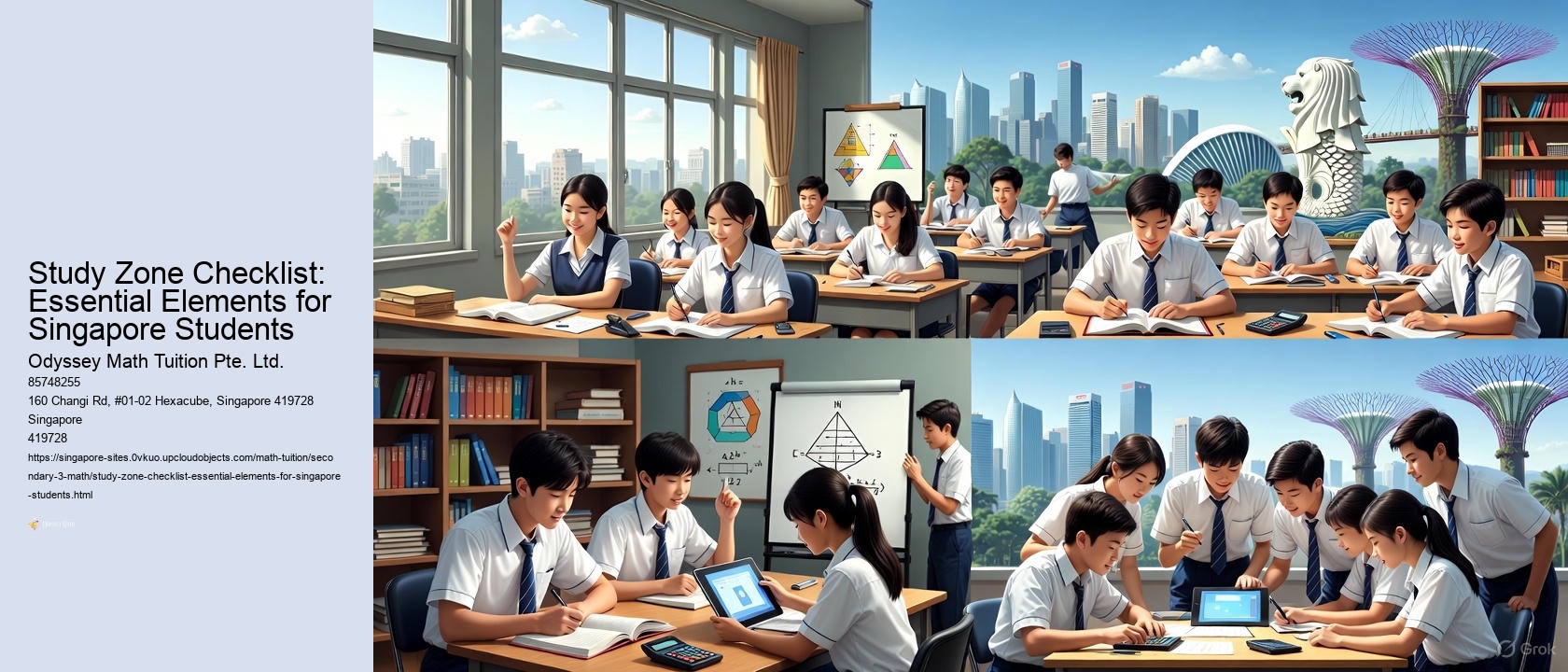
Creating a Conducive Study Environment
Now, before you start hyperventilating about vectors and trigonometry, let's talk about your "study zone." Think of it as your personal mission control. In today's fast-paced educational scene, many parents in Singapore are hunting for effective ways to boost their children's grasp of mathematical principles, from basic arithmetic to advanced problem-solving. Establishing a strong foundation early on can substantially improve confidence and academic achievement, helping students handle school exams and real-world applications with ease. For those investigating options like secondary 3 math it's essential to focus on programs that stress personalized learning and experienced support. This approach not only tackles individual weaknesses but also cultivates a love for the subject, contributing to long-term success in STEM-related fields and beyond.. It's not just a desk; it's a carefully crafted space designed to help you conquer those academic challenges.
Why is this study zone so important, especially in Secondary 3?
Simple. The demands are higher. The content is more complex. You need a space that minimizes distractions and maximizes focus. Forget studying on the sofa with the TV blaring or at the dining table while your family is having dinner. That's a recipe for disaster, confirm plus chop!
So, what makes a good study zone?
Dedicated Space: This is key. It could be a corner of your room, a spare room, or even a thoughtfully organized desk in the living room. The point is, it's your space, dedicated solely to studying.
Comfortable and Ergonomic: A good chair and desk are crucial for long study sessions. You don't want to be battling backaches and neck pain when you should be tackling quadratic equations.
Well-Lit: Good lighting reduces eye strain and keeps you alert. Natural light is best, but a good desk lamp is a must, especially for those late-night study sessions.
Organized: Keep your study area tidy and clutter-free. A messy desk equals a messy mind, kan cheong (anxious) mind!
Minimal Distractions: This means no TV, no video games, and ideally, no phone (unless you're using it for study purposes, of course!).
Fun Fact: Did you know that studies have shown that a dedicated study space can improve concentration by up to 30%? That's like getting an extra 30 minutes of productive study time for every hour you put in! Shiok, right?
Subtopic: The Power of Personalization
Your Study Style Matters: Are you a visual learner? Fill your space with diagrams and charts. Are you an auditory learner? Allow space for listening to recordings or online lessons.
Motivational Elements: Add things that inspire you – photos, quotes, or even small rewards for reaching study goals.
Plants: A little greenery can brighten up your space and improve air quality. Plus, they look nice, what!
Interesting Fact: The ancient Greeks believed that having plants in the study area promoted clear thinking. Maybe they were onto something!
How to excel in Singapore Secondary 3 Math: Let's face it, math can be a real paiseh (embarrassing) subject for some students. But it's also a crucial subject, especially in Singapore.
Why is Math so darn important?
Foundation for Future Studies: Math is the foundation for many other subjects, like physics, chemistry, and economics. If you struggle with math, you'll struggle with these subjects too.
Critical Thinking Skills: Math teaches you how to think logically, solve problems, and analyze data. These are skills that are valuable in any career.
Career Opportunities: A strong foundation in math opens doors to a wide range of careers, from engineering and finance to data science and technology.
AI is Here! With the rise of AI, mathematical skills are becoming even MORE important. Understanding algorithms, data analysis, and computational thinking will be essential for success in the future.
Tips for Singapore Parents and Students on How to Excel in Singapore Secondary 3 Math
Master the Basics: Make sure you have a solid understanding of the fundamental concepts. If you're struggling with a particular topic, go back and review the basics.
Practice, Practice, Practice: Math is not a spectator sport. You need to practice solving problems to improve your skills.
In the challenging world of Singapore's education system, parents are ever more focused on equipping their children with the competencies essential to thrive in intensive math programs, encompassing PSLE, O-Level, and A-Level preparations. Recognizing early signals of struggle in topics like algebra, geometry, or calculus can make a world of difference in fostering resilience and mastery over advanced problem-solving. Exploring dependable math tuition Singapore options can provide tailored assistance that aligns with the national syllabus, guaranteeing students gain the advantage they want for top exam scores. By prioritizing interactive sessions and consistent practice, families can help their kids not only satisfy but surpass academic standards, opening the way for prospective possibilities in high-stakes fields.. In Singapore's challenging education structure, parents play a crucial role in guiding their youngsters through milestone tests that form educational paths, from the Primary School Leaving Examination (PSLE) which assesses basic skills in disciplines like math and scientific studies, to the GCE O-Level exams concentrating on secondary-level mastery in varied fields. As learners progress, the GCE A-Level tests require advanced analytical skills and topic proficiency, commonly deciding tertiary placements and professional trajectories. To keep knowledgeable on all facets of these countrywide evaluations, parents should investigate authorized materials on Singapore test papers provided by the Singapore Examinations and Assessment Board (SEAB). This secures access to the newest programs, examination calendars, sign-up specifics, and guidelines that align with Ministry of Education requirements. Consistently consulting SEAB can help parents prepare successfully, reduce uncertainties, and back their kids in attaining peak results during the competitive landscape..
Seek Help When Needed: Don't be afraid to ask for help from your teacher, tutor, or classmates. There's no shame in admitting that you're struggling.
Use Past Year Papers: Familiarize yourself with the exam format and types of questions by working through past year papers.
Understand the Concepts: Don't just memorize formulas. Understand the underlying concepts so you can apply them to different problems.
Find a Good Tutor: A good tutor can provide personalized instruction and help you overcome your weaknesses.
Stay Positive: Don't get discouraged if you don't understand something right away. Keep practicing and you'll eventually get it. Jia you! (Add oil!)
History Tidbit: Did you know that the concept of zero wasn't widely accepted in Europe until the 12th century? Imagine trying to do math without zero! Siao liao! (Crazy!)
Remember, Secondary 3 is a crucial year. But with a dedicated study zone, effective study strategies, and a positive attitude, you can conquer those academic challenges and set yourself up for success. Don't be blur like sotong (clueless) – start planning your attack now!
What is a Study Zone Checklist and why is it important for Singapore Secondary 3 students?
A Study Zone Checklist helps Secondary 3 students in Singapore create an effective and conducive learning environment. It ensures they have all the necessary resources and a distraction-free space to maximize their study sessions and exam preparation.
How can parents help their Secondary 3 child create an effective study zone?
Parents can assist by providing a quiet, dedicated space, ensuring adequate lighting and ventilation, and helping to organize study materials. They can also set clear boundaries regarding screen time and distractions during study hours.
What are the essential elements of a good study zone for a Secondary 3 student in Singapore?
Essential elements include a comfortable desk and chair, good lighting, organized study materials (textbooks, notes, stationery), minimal distractions (no TV or social media), and a personal touch to make the space inviting.
How often should a Secondary 3 student review and update their Study Zone Checklist?
Ideally, students should review their checklist weekly to ensure their study zone remains effective and organized. Adjustments should be made based on changing needs and study habits.
What role does technology play in a Secondary 3 students study zone, and how can it be managed effectively?
Technology, like computers and tablets, is essential for research and online learning. However, its crucial to manage distractions by using website blockers, setting time limits, and keeping phones away during focused study periods.
How can a Study Zone Checklist help improve a Secondary 3 students focus and concentration?
By minimizing distractions and ensuring all necessary materials are readily available, a well-organized study zone reduces the mental clutter that can hinder focus and concentration.
What are some common mistakes to avoid when setting up a study zone for a Secondary 3 student?
Common mistakes include studying in bed, having too many distractions, poor lighting, and a lack of organization. These can lead to decreased productivity and increased stress.
How can a Secondary 3 student personalize their study zone to make it more motivating and enjoyable?
Students can personalize their space with motivational posters, plants, comfortable seating, and items that inspire them. Creating a positive and inviting atmosphere can make studying more enjoyable.
What are some affordable options for creating an effective study zone for Secondary 3 students in Singapore?
Affordable options include repurposing existing furniture, using free online resources for organization tips, and borrowing books from the library instead of buying them.
How can a Secondary 3 student use a Study Zone Checklist to track their progress and stay accountable?
The checklist can be used to ensure all necessary tasks are completed before each study session. Students can also track their progress over time and identify areas where they need to improve their study habits or environment.